If you have recurring back pain, you’ve probably tried strengthening your core, loosening your hips and stretching your back. Those strategies can help, but they don’t always provide a complete solution. When pain lingers or flares up during everyday movements, it’s often a sign that a critical area is being overlooked: your rib cage.
Because all 12 vertebrae of your thoracic spine (middle segment) connect to your rib cage, rib mobility plays a central role in how your spine moves and how forces are managed through your back. When rib motion is limited, upper-body and mid-back movement are also restricted. The result is not just overall tension but added strain on your lower back.
Rib cage stiffness goes largely unnoticed because it develops gradually through factors such as less-than-optimal breathing mechanics and poor movement patterns. With a few simple, daily exercises, you can counter the causes of rib immobility and restore healthy motion that relieves and prevents back pain.
When your rib cage becomes stiff, it compromises healthy thoracic motion, forcing the lumbar spine in the lower back to pick up the slack. This compensation pattern is common in people who sit for long hours, train with limited focus on rotation or habitually hold tension in their upper bodies.
Your lumbar spine is designed primarily for stability and not large degrees of rotation, so the stress of compensating takes a toll. Over time, your nervous system senses instability and responds by creating protective tension, further limiting movement and increasing pain as a warning signal.
Why breathing matters
Rib mobility is a critical component of proper breathing. The ribs need to expand and contract for the diaphragm — your primary breathing muscle — to function. When your breath becomes shallow or chronically upper-chest-oriented, rib movement diminishes further.That restriction creates a dysfunctional cycle that ultimately contributes to back pain. Limited rib mobility interferes with the ability to breathe deeply, triggering your body’s stress response, which increases muscle tensing as a guarding mechanism. In turn, that tension further reduces movement options for the spine, especially during rotation and extension. For many people with back pain, this cycle has been unfolding quietly for years.
Restoring rib cage mobility with breathing-based exercises helps break that loop. Improved rib motion supports deeper breathing and vice versa, while both reduce protective tension and enable healthy spine movement.
Positional breathing exercises to restore rib mobility
The following three categories of exercises emphasize a focus on rib and spinal movement powered by slow, deep, diaphragmatic breaths. As you practice them, move within a comfortable range and stop if you feel pain or experience difficulty breathing.
Consult your doctor or physical therapist before beginning any new exercise program.
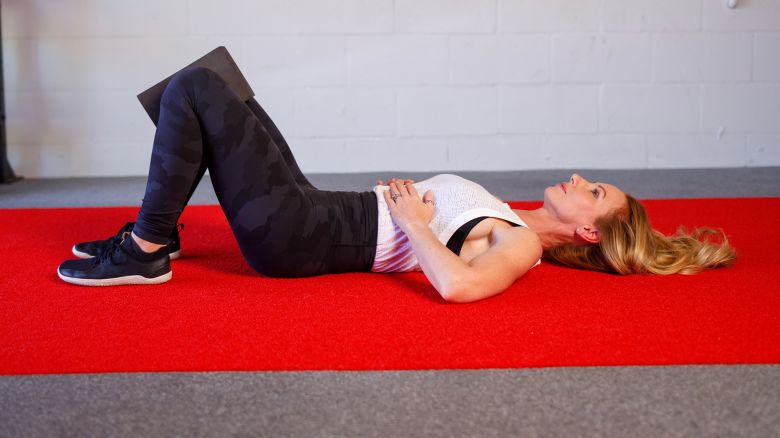
1. Breathing with hand-guided rib movement. Your hands are your best tool for guiding and monitoring rib movement as you work to optimize your breathing mechanics. Align your fingers along your lower ribs so you can feel the expansion outward under your palms as you inhale and gently press inward as you exhale.
Take six long, deep breaths with extended exhalations, pausing slightly between breaths. I recommend a 5-count inhale, 7-count exhale, 3-count pause pattern. You can do this exercise standing, sitting or lying down with knees bent and feet on the floor in a bridge position, as shown in the video below.
2. Breath-fueled rotation. Because your ribs and spine are connected, healthy twisting relies on the mobility of your rib cage. Since your breath drives rib movement, you can leverage it for better spinal rotation.
The instructions below are for a seated rotation, but the breathing cues can apply to rotational exercises from a variety of positions, including standing or lying on your side.
- Sit with your feet on the floor, hip-distance apart.
- As you inhale, reach your right arm out to the right side at shoulder height with your palm up.
- Rotate from your mid-back and reach behind you, as you exhale.
- Hold the rotation for five long, deep breaths — gradually increasing the rotation with each breath, if possible.
- As you inhale, focus on expanding the open side of your rib cage (the side you’re turning toward).
- As you exhale, engage your side waist muscles on the opposite side to help rotate your rib cage into the thoracic twist.
- After your fifth breath, unwind back to center and repeat the steps, rotating to the left.